State Bank of India Mutual Fund
Fundamentals
| SBI Mutual Fund Unlisted Shares Price | Rs 775 Per Equity Share | Market Cap (in cr.) | Rs 157437 |
| Lot Size | 100 Shares | P/E Ratio | 62 |
| 52 Week High | Rs 2775 | P/B Ratio | 18.97 |
| 52 Week Low | Rs 675 | Debt to Equit | 0 |
| Depository | NSDL & CDSL | ROE (%) | 30.61 |
| PAN Number | AAACS7339D | Book Value | 40.85 |
| ISIN Number | INE640G01020 | Face Value | 1 |
| CIN | U65990MH1992PLC065289 | Total Shares | 2031443768 |
| RTA | Computer Age Management Services (CAMS) |
Shareholding Pattern
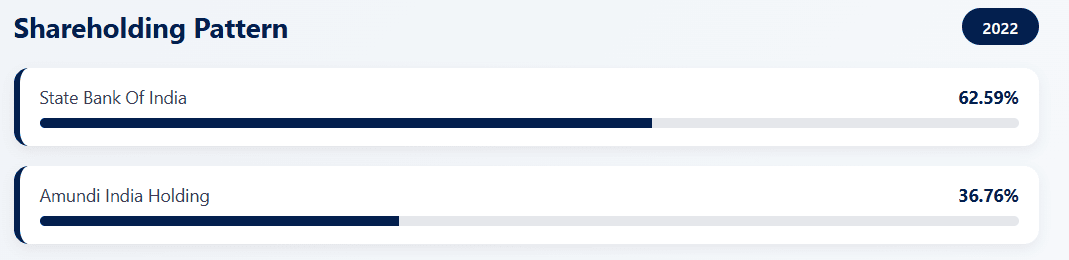
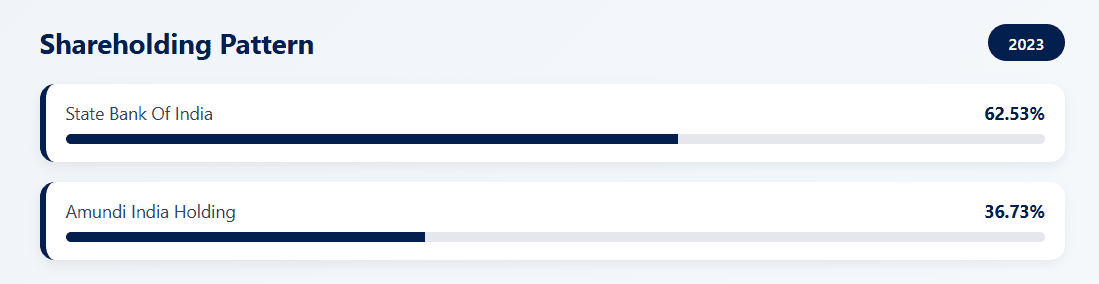
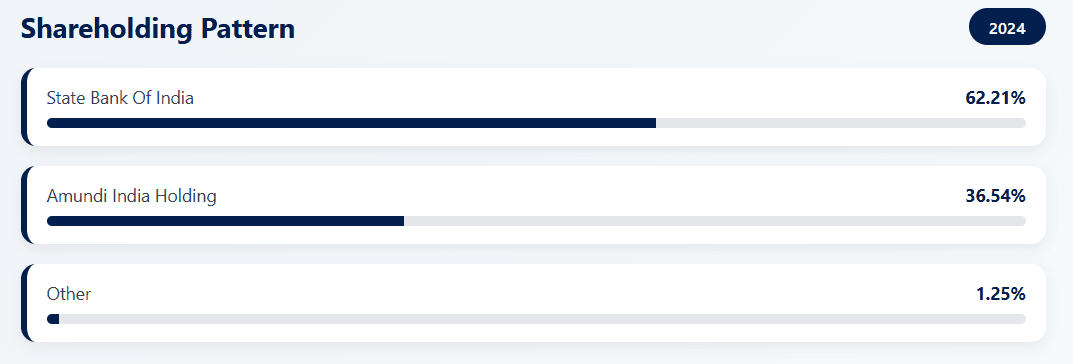
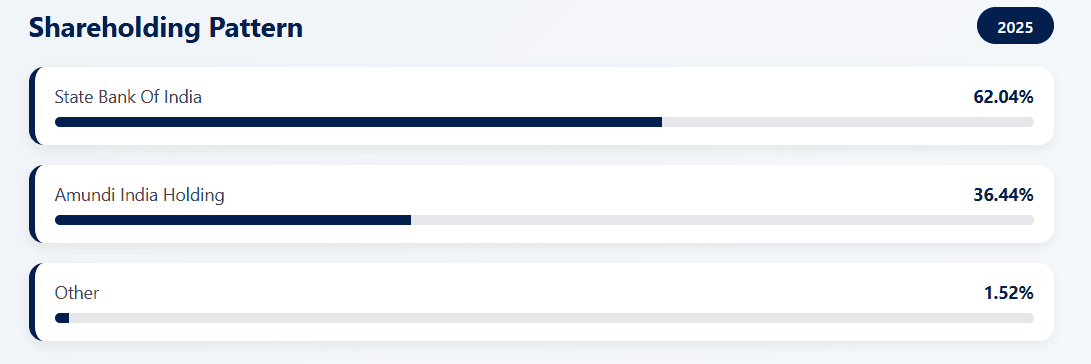
State Bank of India Mutual Fund

Established in 1987 as a joint venture between State Bank of India and France's Amundi, SBI Mutual Fund is one of India's largest and most trusted asset managers. Headquartered in Mumbai and led by CEO Nand Kishore, it manages over Rs 10.38 lakh crore in assets as of 2025. The firm offers a diverse portfolio of 80+ schemes, including equity, debt, and innovative ESG-based funds, serving over 26 million investor folios.
By combining SBI's massive domestic retail reach with Amundi's global expertise, the company has secured a top-three market position. Known for disciplined risk management and ethical governance, it maintains a nationwide presence across 290+ branches.
Company Business Model
SBI Mutual Fund operates an asset management business model, managing investor money across diversified investment schemes and earning fee-based income.
Mutual Fund Scheme Management
Manages equity, debt, hybrid, liquid, and passive (ETF/index) funds for retail and institutional investors.
Asset-Based Fee Income
Earns revenue through management fees (AUM-linked) charged on funds managed.
Fund Distribution Network
Leverages SBI's vast banking network, distributors, and digital platforms for scale and low-cost customer acquisition.
Investment & Risk Management
Uses professional fund managers and research teams to generate returns while managing market and credit risk.
Competitors
SBI Mutual Fund competes in India's asset management industry with the following major AMCs:
HDFC Mutual Fund
One of India's largest AMCs with strong equity, debt, and hybrid fund performance.
ICICI Prudential Mutual Fund
Diversified AMC with a strong presence in retail, institutional, and passive funds.
Axis Mutual Fund
Known for strong equity fund performance and growing SIP investor base.
Kotak Mahindra Mutual Fund
Offers a broad range of equity, debt, and passive investment solutions.