Skip to searchSkip to main content

National Stock Exchange of India (NSE)
Company Overview
Balance Sheet Analysis
Cash Flow Statement Analysis
Profit & Loss Statement Analysis
Financial Insights
Premium Insights
Company Overview
Balance Sheet Analysis
Cash Flow Statement Analysis
Profit & Loss Statement Analysis
Financial Insights
  • Strong Top-line Growth: Revenue has grown at a CAGR of 17.7%, indicating significant market expansion and dominance.
  • High Profitability: The company maintains a massive average Net Margin of 62.4%, suggesting a near-monopoly status with a very strong competitive moat.
  • Improving Efficiency: Net Profit Margins have expanded by 12.9% points, showing that costs are growing slower than reenue (operating leverage).
  • Debt-Free Status: operating with 0.00x Debt-to-Equity, providing immense financial stability and resilience against market downturns.
  • Cash Cow: Cumulative Cash Flow from Operations (CFO) is 124% of Net Profit, meaning the quality of earnings is exceptional
Premium Insights

Fundamentals

NSE India Limited  Unlisted Shares Price ₹ 2075 Per Equity ShareMarket Cap (in cr.)₹ 513563
Lot Size
  250 SharesP/E Ratio42.14
52 Week High₹ 2400P/B Ratio16.92
52 Week Low ₹ 1625Debt to Equit 0
DepositoryNSDL & CDSLROE (%) 40.15
PAN Number AAACN1797LBook Value122.64
ISIN NumberINE721I01024Face Value1
CIN U67120MH1992PLC069769Total Shares 2475000000
RTALink Intime

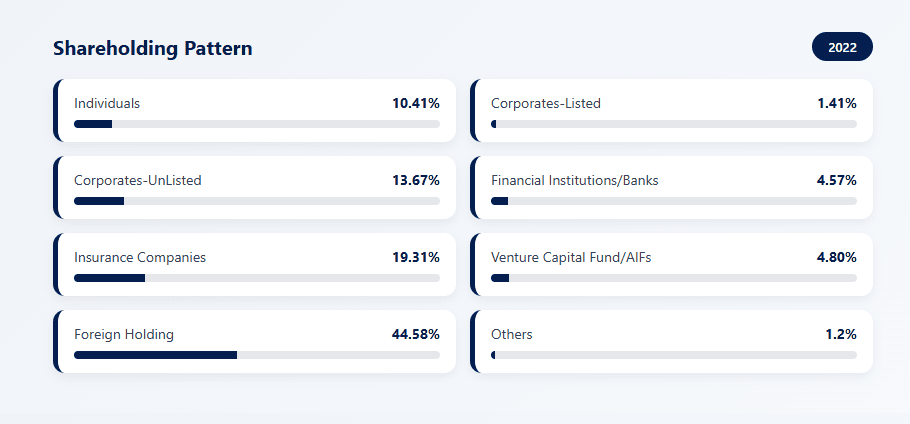
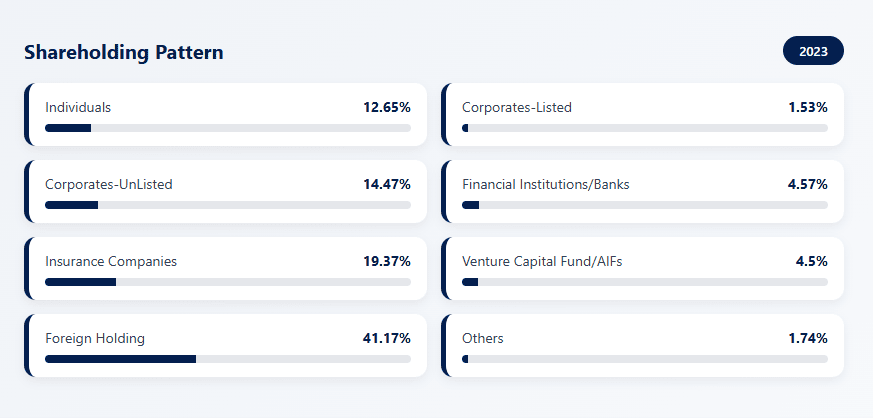
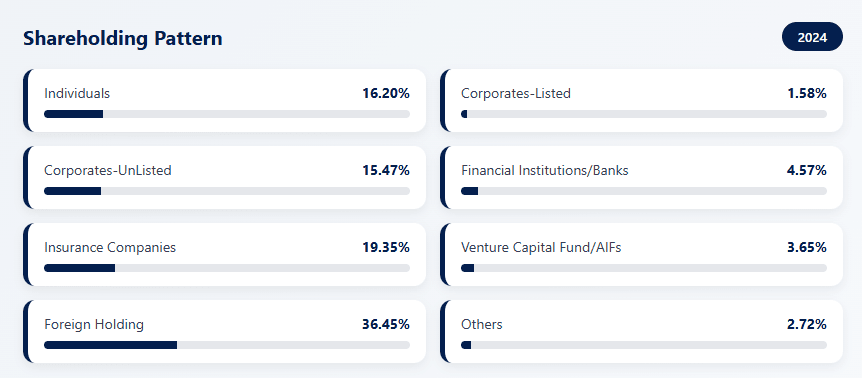
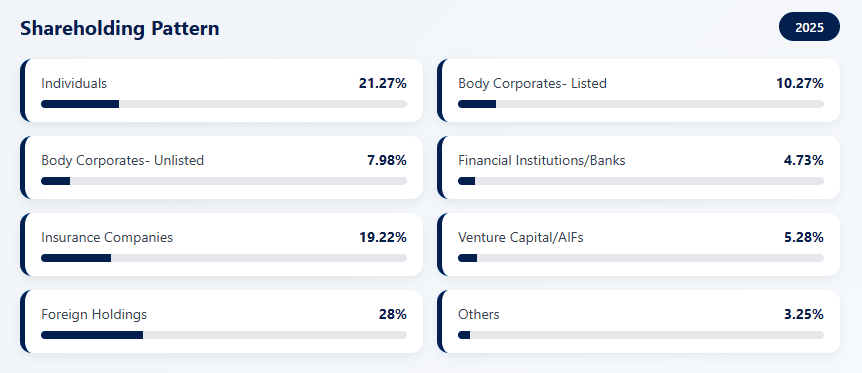
Shareholding Pattern

2022
2023
2024
2025
2022
2023
2024
2025

National Stock Exchange of India (NSE)

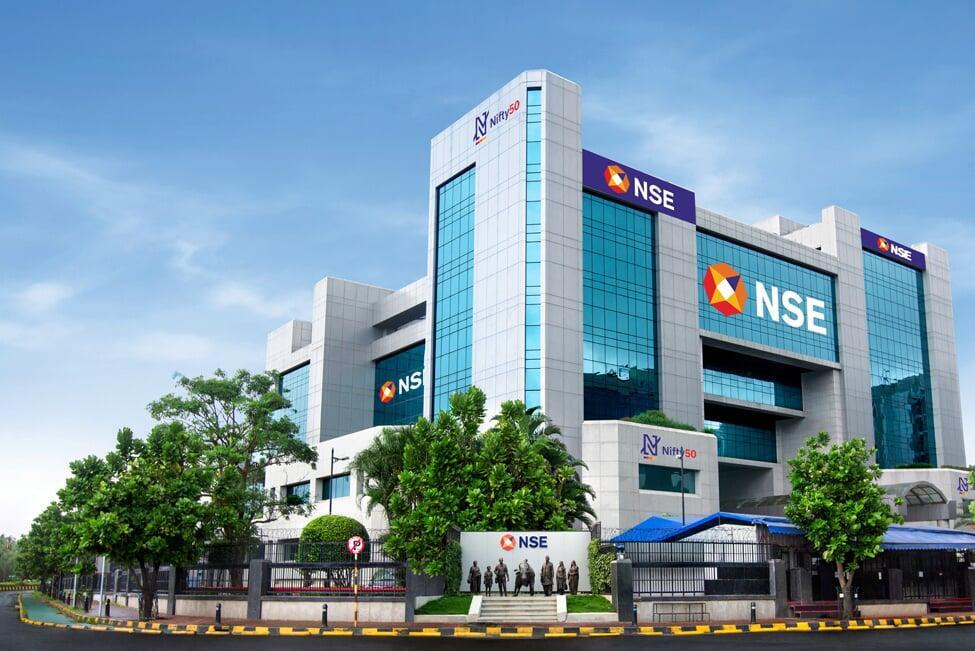
Established in 1992 and headquartered in Mumbai, the National Stock Exchange (NSE) is a cornerstone of India’s financial infrastructure. It revolutionized the domestic capital market by introducing a nationwide electronic screen-based trading system in 1994, successfully replacing the traditional open outcry method. Regulated by SEBI, the NSE provides a transparent and efficient platform for trading equities, derivatives, debt, and currencies.

Its flagship benchmark, the Nifty 50, was launched in 1996 and tracks 50 major companies, serving as a vital barometer for the Indian economy. Under the leadership of CEO Ashishkumar Chauhan, the exchange utilizes an advanced automated order book to ensure rapid trade execution. Clearing and settlement are managed by its subsidiary, the National Securities Clearing Corporation Limited (NSCCL).

Company Business Model

The National Stock Exchange of India operates a multi-revenue financial market infrastructure business that enables trading, clearing, settlement, and data dissemination across capital markets.

Trading Platform Operations

NSE provides electronic trading platforms for equities, equity derivatives, currency derivatives, debt instruments, and ETFs, earning revenue through transaction and trading fees.

Clearing & Settlement Services

Through its clearing corporation (NSE Clearing Limited), NSE ensures risk management, margining, and settlement guarantee, generating income from clearing and settlement charges.

Market Data & Index Services

NSE monetizes real-time and historical market data, index licensing (e.g., NIFTY indices), and analytics services sold to brokers, institutions, and global financial firms.

Technology & Connectivity Services

The exchange offers co-location, connectivity, and trading infrastructure services to market participants, creating stable, recurring technology-driven revenues.

Competitors

NSE operates in India’s financial market infrastructure space and competes with the following exchanges

BSE Limited

India’s oldest stock exchange, competing with NSE in equity trading, derivatives, listings, and market data services.

Metropolitan Stock Exchange of India

Competes mainly in currency derivatives and debt market segments, though with lower volumes.

National Commodity & Derivatives Exchange 

Indirect competitor through derivatives trading, primarily in agricultural commodities. 

Multi Commodity Exchange of India 

Competes indirectly in the derivatives ecosystem, especially for non-agricultural commoditie

SWOT Analysis

Strengths

  • Dominant Market Leadership : NSE commands ~90%+ market share in equity derivatives and majority share in cash equities, creating unmatched liquidity and network effects.
  • High-Margin, Asset-Light Model : Exchange business operates with low capex and high operating leverage, resulting in strong cash flows and profitability.
  • Technology & Speed Advantage : World-class electronic trading infrastructure with ultra-low latency attracts institutional and HFT participants.
  • Strong Clearing & Risk Management : NSE Clearing Limited provides robust settlement guarantee, strengthening systemic trust and regulatory confidence.
  • Powerful Brand & Indices Franchise : NIFTY indices are widely used for ETFs, derivatives, and global benchmarking—creating recurring, sticky revenue streams.

Weaknesses

  • Regulatory Sensitivity : NSE’s operations and pricing are heavily regulated, limiting pricing flexibility and innovation speed.
  • Reputation Overhang (Historical) : Past governance and co-location controversies continue to delay IPO plans and affect valuation sentiment.
  • Revenue Concentration : Significant dependence on derivatives trading volumes, which are sensitive to market cycles and regulations.
  • India-Centric Exposure : Business is almost entirely domestic, limiting geographic diversification.

Opportunities

  • IPO & Listing Upside NSE’s own IPO remains a major valuation and liquidity trigger for unlisted shareholders.
  • Rising Financialization in India Increasing retail participation, SIP flows, ETFs, and derivatives usage directly expand NSE’s addressable market.
  • Data, Analytics & Index Monetization Growing demand for market data, indices, and analytics from global investors offers high-margin growth.
  • New Products & Platforms Scope to expand in international exchanges, commodity platforms, SME listings, and new derivatives.

Threats

  • Regulatory Intervention Risk : Sudden changes in margin rules, derivatives norms, or transaction charges can materially impact volumes.
  • Competitive Pressure from BSE : BSE’s revival in derivatives and aggressive pricing could erode NSE’s dominance over time.
  • Market Volatility Cycles : Prolonged low-volatility or bearish markets reduce trading activity and transaction revenues.
  • Disruptive Trading Models : Long-term threat from decentralized finance or alternative trading platforms, though currently limited.

Annual Report