Skip to searchSkip to main content

API Holdings PharmEasy Limited

Company Overview
Balance Sheet Analysis
Cash Flow Statement Analysis
Profit & Loss Statement Analysis
Financial Insights
Premium Insights
Company Overview
Balance Sheet Analysis
Cash Flow Statement Analysis
Profit & Loss Statement Analysis
Financial Insights

    Turnaround Story: Net Profit Margins have improved drastically by 43.0% points, indicating the company is successfully trimming losses and moving toward profitability.
    Cash Flow Warning: Cumulative CFO is only 27% of Net Profit. Even as accounting losses narrow, the actual cash burn remains a concern.
    Scale: Generated 5,872 Cr in revenue in the latest period, solidifying its position as a major player despite profitability challenges
    Working Capital Lockup: Inventory and receivables management is critical as cash conversion remains low.
Premium Insights

Fundamentals

 PharmEasy  Unlisted Shares Price ₹ 6.5 Per Equity ShareMarket Cap (in cr.)₹ 11071
Lot Size
  5000 SharesP/E RatioN/A
52 Week High₹ 9P/B Ratio3.39
52 Week Low ₹ 6.5Debt to Equit 0.62
DepositoryNSDL & amp; CDSLROE (%) -48.05
PAN Number AASCA1201EBook Value1.92
ISIN NumberINE0DJ201029Face Value1
CIN U60100MH2019PLC323444Total Shares 17032495304
RTALink Intime

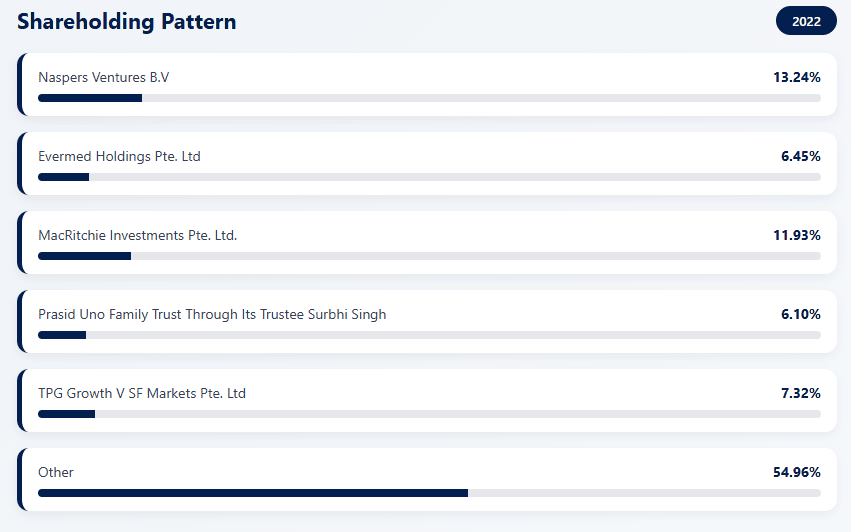
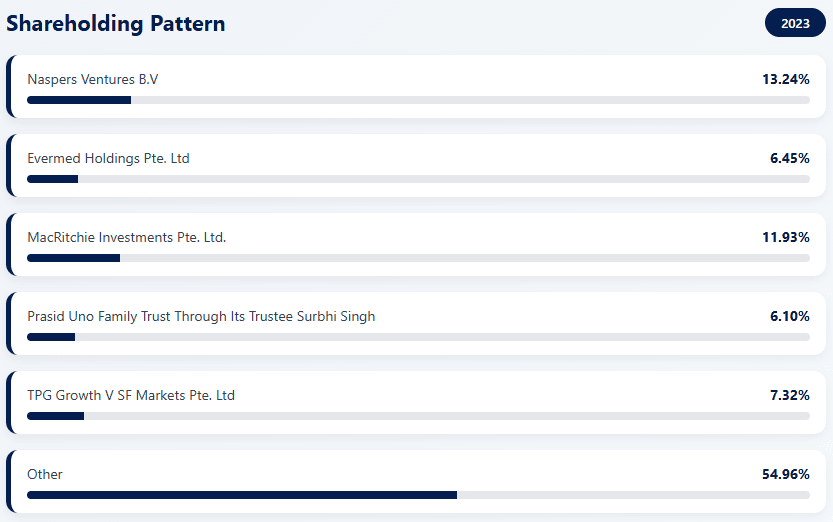
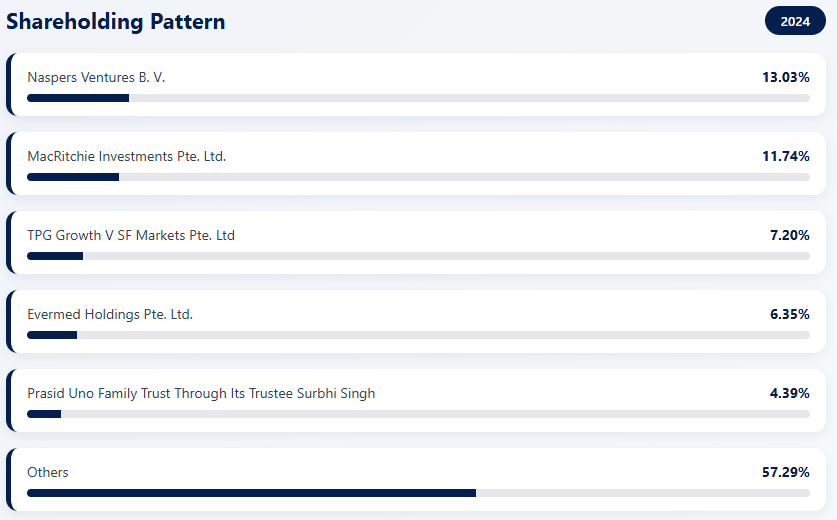
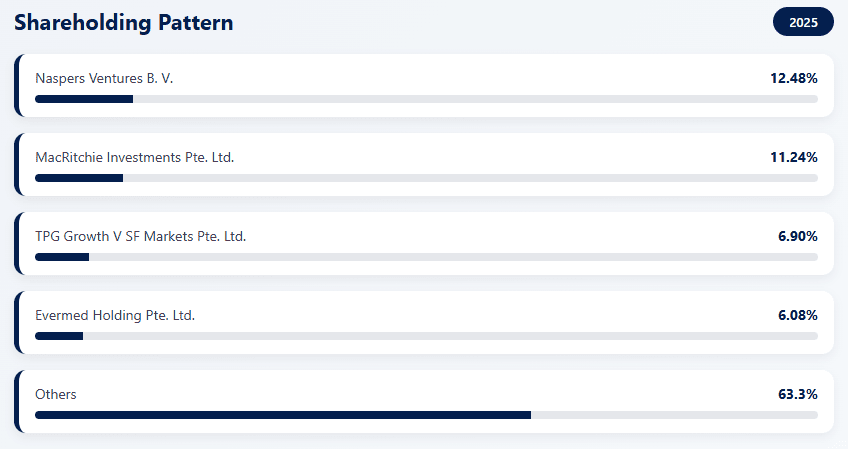
Shareholding Pattern

2022
2023
2024
2025
2022
2023
2024
2025

API Holdings PharmEasy Limited

API Holdings Limited is the Mumbai-based parent company of PharmEasy, India’s prominent integrated digital healthcare platform. It operates an end-to-end ecosystem connecting consumers, pharmacies, and diagnostic labs through a sophisticated tech stack that includes B2C e-pharmacy services, large-scale diagnostics via Thyrocare, and B2B supply chain solutions through Retailio and Aknamed.

As of early 2026, the company has pivoted from aggressive expansion to a "turnaround" strategy focused on debt reduction and unit economics. After a significant valuation down-round in 2023, the platform has successfully halved its annual losses to approximately ₹1,572 crore (FY25) and refinanced its debt through NCDs. While it previously dominated the market, recent data shows it now faces intense competition from Tata 1mg, which holds a lead in market share. Despite these challenges, API Holdings remains a major private player delivering to over 1,000 cities, with ongoing preparations to potentially revisit its IPO in 2026 or 2027.

Company Business Model

API PharmEasy Limited operates a digital healthcare commerce platform that connects consumers with medicines, diagnostics, and healthcare services through a technology-driven, asset-light model.

Online Pharmacy Sales

Generates revenue by selling prescription and OTC medicines directly to consumers via its app and website.

Diagnostics Aggregation

Earns commissions by facilitating lab test bookings through partnered diagnostic providers.

Integrated Supply Chain

Backward integration into pharmaceutical distribution improves margins, availability, and delivery efficiency.

Private Label Products

Sells in-house wellness and healthcare products to enhance profitability.

Competitors

PharmEasy competes with major digital health platforms (Tata 1mg, Apollo 24|7, Netmeds) and omni-channel pharmacy chains, with competition centered on pricing, delivery speed, diagnostics integration, and customer retention.

Tata 1mg

Online pharmacy, diagnostics, and doctor consultations.

Apollo 24|7

Backed by Apollo Hospitals; strong omni-channel presence.

Netmeds

Reliance-backed e-pharmacy with nationwide reach.

Practo

 Consultations and diagnostics with pharmacy integration.

SWOT Analysis

Strengths

  • Market Leadership : One of India’s largest e-pharmacy platforms with strong brand recall and customer base.
  • End-to-End Healthcare Ecosystem : Integrated pharmacy + diagnostics + digital health, increasing repeat usage and customer stickiness.

  • Backward Supply Chain Integration : Ownership of pharma distribution improves cost control, availability, and margins.

  • High Repeat Demand Business : Medicines and chronic care ensure recurring consumption-driven revenues.

  • Data & Private Labels : Customer data enables targeted marketing and higher-margin private label products.

Weaknesses

  • Profitability Pressure : High customer acquisition costs and discounting impact near-term profitability.
  • Regulatory Dependence : E-pharmacy rules, pricing norms, and compliance requirements pose operational constraints.
  • Complex Operations : Managing logistics, prescriptions, diagnostics, and compliance increases execution risk.
  • Integration Challenges : Past acquisitions increase complexity and delay margin normalization.

Opportunities

  • Rapid Digital Health Adoption : Rising internet penetration and healthcare digitization expand addressable market.
  • Chronic & Preventive Care Expansion : Subscription-based care, wellness plans, and diagnostics bundles offer margin upside.

  • Operating Leverage : Scale-driven improvement can significantly enhance unit economics.

  • IPO / Strategic Exit Potential : Platform scale and data assets offer future listing or strategic acquisition optionality.

Threats

  • Intense Competition : Strong rivals like Tata 1mg, Apollo 24|7, Netmeds, and Amazon keep pricing pressure high.
  • Policy & Legal Risk : Any adverse regulation on e-pharmacy can disrupt growth.

  • Margin Compression : Price wars and logistics costs can delay sustainable profitability.

  • Customer Switching Risk : Low switching costs reduce long-term pricing power.

Annual Report